Most of us treat offices, libraries, and kitchen counters as inert scenery, like the backdrop in a video‑game level. Cognitive science says otherwise. Our neural hardware—calibrated on Paleolithic plains—keeps reading walls, windows, light, sound, and even the air itself for cues about safety, opportunity, and social affordances.
Those cues quietly bias how abstract or concrete our thoughts become, how quickly the prefrontal cortex tires, and whether a flash of insight ever makes it onto the page. The built environment, in short, is a co‑author of your work. Below are five evidence‑backed adjustments—simple enough to try tomorrow—that reveal just how plastic productivity can be.
1. Raise—or lower—the roof
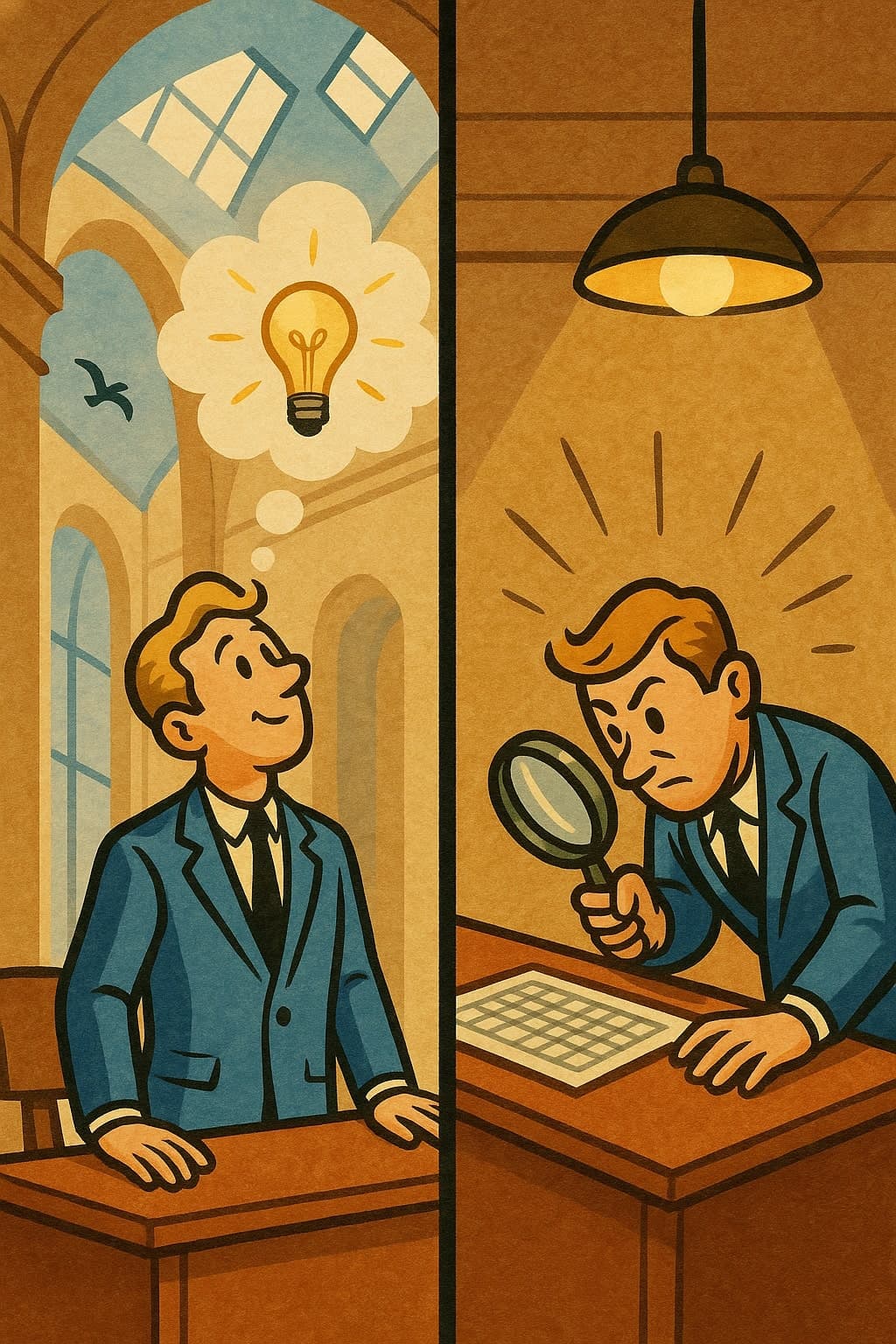
In a classic series of experiments, marketing scholars Joan Meyers‑Levy and Rui Zhu found that a high ceiling primes "freedom," nudging people toward relational, big‑picture reasoning; a low ceiling primes "confinement," steering them to detail‑oriented, item‑specific processing.
Put it to work:
- For strategic brainstorming, decamp to a vaulted atrium, an open‑plan common room, or even a park pergola.
- When you must debug code or proof‑read a legal brief, tighten the visual envelope—closing a door, lowering an adjustable pendant lamp, or shrinking the video‑chat frame can simulate the same cognitive gear‑shift.
2. Harvest daylight like a crop

Natural light is more than an aesthetic; it is a metabolic input. Research led by Cornell ergonomist Alan Hedge showed that offices optimized for daylight reported 51% less eyestrain, 63% fewer headaches, and 56% lower drowsiness—all precursors to mental slip‑ups. (Generative Design with Daylight Analysis - Metal Architecture)
- Rotate your desk perpendicular to the window so luminance spreads evenly across screens and paper.
- Replace opaque blinds with translucent roller shades that diffuse glare without throttling lux.
- If your apartment faces a brick wall, an LED task lamp in the 5,000–6,500 K range mimics the spectral profile of noon light surprisingly well.
3. Let chlorophyll carry some cognitive load
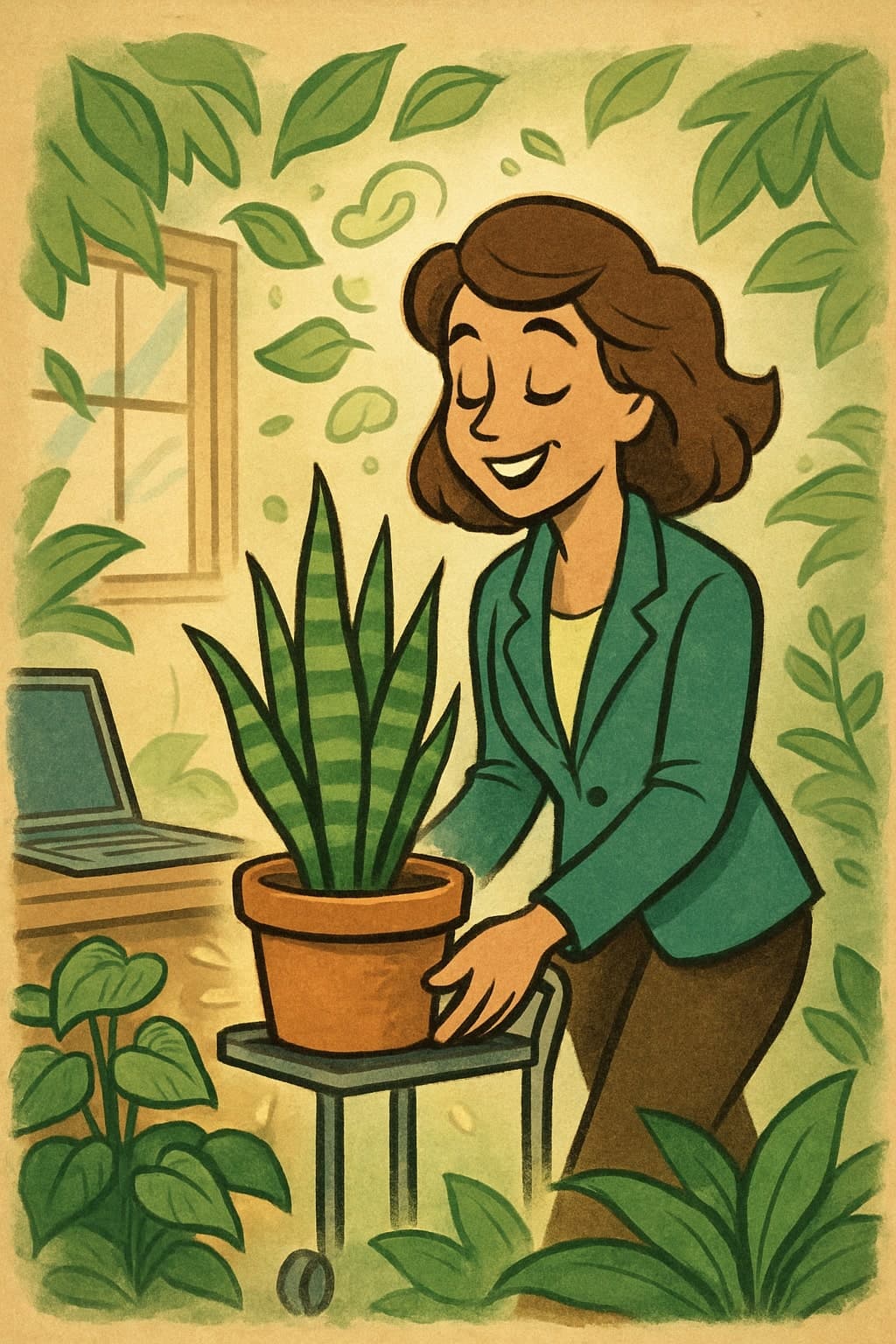
A longitudinal field study in British and Dutch offices found that adding waist‑high plants lifted productivity by 15% while boosting perceived air quality and job satisfaction. (Featured news - Why plants in the office make us more productive - University of Exeter) Researchers interpret the effect through "attention‑restoration" theory: soft‑fascinating stimuli such as leaves or gentle movement allow the brain’s executive network to micro‑recover between bouts of focused effort.
- Start with hardy species—pothos, ZZ‑plant, or snake plant—that tolerate office neglect.
- Place greenery within peripheral vision rather than dead‑center on the monitor; the quick, effortless glance is what restores attention.
- One medium plant per 10 m² is enough to capture most of the benefit.
4. Tune the background to 70 decibels

Silence isn't always golden. Across five experiments, Mehta, Zhu, and Cheema showed that a moderate ambient noise (≈70 dB) increases creativity compared with both quiet (50 dB) and loud (85 dB) settings. The mild auditory "masking" imposes just enough processing difficulty to kick the brain into higher‑level abstraction, the wellspring of novel ideas. (Is Noise Always Bad? Exploring the Effects of Ambient Noise on Creative Cognition)
- Stream a "coffeehouse ambience" loop or gentle rain track, keeping the volume at roughly dishwasher level.
- Crack a window if traffic is distant; urban murmur often sits in the sweet spot.
- When analyzing data or doing compliance work, dial the sound down—creative gain can turn into accuracy loss.
5. Prime the nose for alertness

Olfaction has a direct neural hotline to the limbic system. In a randomized controlled trial, inhaling peppermint essential oil sharpened memory and increased subjective alertness relative to both a floral scent and a no‑odor control. (Modulation of cognitive performance and mood by aromas of peppermint and ylang-ylang - PubMed)
- Keep a peppermint roller or inhaler at hand; one swift sniff is plenty.
- Avoid continuous diffusers—the aim is a brief cognitive "ping," not sensory overload.
- Reserve peppermint for afternoon slumps so your brain continues to associate the aroma with vigilance rather than habituation.
The architecture of agency
Environments do not force behaviour, but they load the dice. By nudging ceiling height, daylight, biophilic texture, acoustic texture, and even molecular texture, you can tilt daily experience toward clarity, creativity, and stamina—without adding a minute to your schedule.
"We are not ghosts in the machine but organisms in a niche; redesign the niche and the organism rewrites its own code."
Try one intervention this week, notice what moves the needle, and remember: the most powerful tool on your desk may be the room itself.
Share this: